


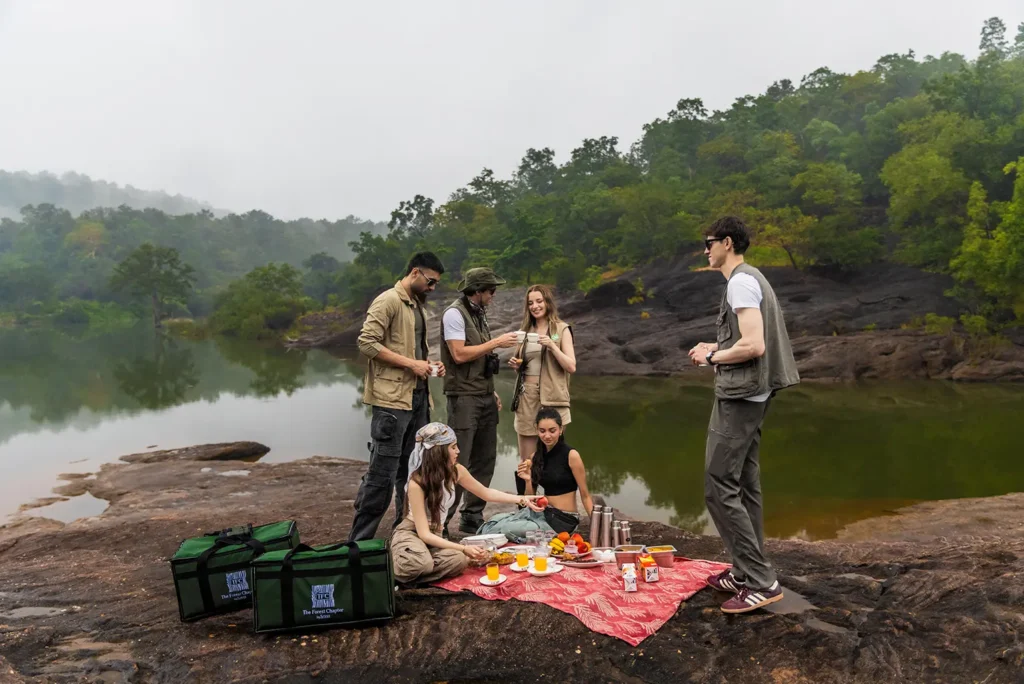
A safari in India is usually planned months ahead. You book permits, check the park timings and set an alarm for a reporting time that may come before sunrise. What you will eat that day, however, is often left to the last minute.
Yet food is one of the simplest ways to understand the landscape beyond the safari track. Around India’s national parks, the resort is usually your main kitchen, and the food served there can draw from the crops, cooking traditions and communities around the forest. A meal of millet bread in Gujarat tells a different story from sour fish in Assam or spice-led cooking in the south.
There is no single cuisine of the Indian forest. Each region has its own ingredients, techniques and food traditions. Indian food while travelling is as much about understanding where you will eat, what each forest puts on the plate and how the seasons shape those ingredients as it is about the food itself. Paying attention to these details can give you a deeper sense of the place you are visiting.
Near India’s National Parks, the Resort Is Usually Your Kitchen
A forest holiday comes with a different eating schedule from a city break. Around many national parks, settlements are scattered and independent restaurants can be hard to find. Kaziranga is a good example. Once you are staying near the park, most meals are likely to happen at the resort.
Your safari timings largely decide when you eat. Tea may be ready before a dawn safari, followed by brunch when you return. Lunch comes before the afternoon drive, and dinner waits until you are back from the evening safari. Meals are planned around the hours when you are in the forest.
Many lodges therefore rely on multi-cuisine buffets, particularly when guests arrive from different parts of India and overseas. But regional cooking is becoming a more visible part of lodge dining, with kitchens paying closer attention to the local ingredients and food near wildlife resorts that reflect their surroundings. At Ember & Leaf at The Forest Chapter by Sayaji in Sasan Gir, for instance, local flavours are explored alongside global techniques.
That makes the regional cuisine worth seeking out. Try the local delicacies, ask about the ingredients and learn how the food connects to the communities around the forest. Often, the table offers a glimpse of the region’s culture that a safari alone cannot provide.
A Forest-by-Forest Guide to What’s on the Plate
If you have never travelled through these regions, some of the food names may be unfamiliar. That is part of what makes them worth exploring. From millet breads in Gujarat to sour fish in Assam, each region has its own ingredients, dishes and cooking traditions. Here is what to look for as you travel from one forest to another.
1. Sasan Gir, Gujarat — The Food of the Maldharis
In Gir, start with bajra rotla, a thick flatbread made from pearl millet. Bajra grows well in Gujarat’s dry conditions and has long been part of everyday food here. Traditionally served hot with a generous amount of ghee, it pairs particularly well with something sharp and spicy on the side.
That might be garlic chutney, while ringan no olo brings smoky roasted aubergine to the plate and sev tameta combines tomatoes with crisp strands of gram flour. Chaas, the lightly seasoned buttermilk found across Gujarat, provides a cooling counterpoint.
The food becomes more meaningful when you understand the communities around Gir. The Maldharis are pastoral communities who live alongside the lions, keeping livestock that also supplies much of the dairy central to the local diet. Food near Gir National Park is often closely tied to the Maldharis’ pastoral way of life, shaped by their livestock, dairy traditions and long relationship with the forest landscape.
2. Central India — Millets, Mahua and Forest Kitchens
Across central India’s forests, food is tied to the grains, plants and communities that have lived here for centuries. Kodo and kutki are small millets traditionally grown across the region, while mahua flowers are gathered seasonally and feature in the food traditions of several communities.
Around Madhai, these ingredients are closely linked to the Gond and Korku communities and their food traditions. You may find kodo-kutki bhat, pej, mahua-based preparations and millet rotis, while kutki kheer, made with the small millet and milk, is part of Gond food traditions. Paan roti, cooked in sal leaves, is a Korku preparation.
The same influences extend towards Kanha and Bandhavgarh, where Baiga and Gond thalis bring together millets, vegetables, pulses and other local preparations. Further west at Tadoba, the food takes on a stronger Maharashtrian character. Zunka-bhakri combines a dry, spiced gram flour preparation with bhakri, while Saoji curries are known for their assertive use of spices.
Central Indian food is not one fixed cuisine. Ingredients overlap, but preparations change with the community and region.
3. Ranthambore and Corbett — Two Very Different Northern Plates
Ranthambore sits in Rajasthan, where traditional cooking has long been shaped by ingredients suited to a dry climate. Ker sangri is a good example. Ker is a small desert berry, while sangri is the bean of the khejri tree. Both can be dried and stored, making them useful ingredients in a region where fresh produce has traditionally been less readily available.
You may also encounter gatte, gram-flour dumplings cooked in a spiced gravy, and bajra roti with lehsun chutney. Bajra features strongly in the food cultures of dry parts of western India, where millets have long been an important staple.
Corbett tells a totally different story. In the Kumaoni food of Uttarakhand, bhatt ki churkani is made with bhatt, a dark local pulse, while madua roti uses finger millet. These are foods of the hills rather than the desert, shaped by what local communities can grow, store and cook with.
4. Kaziranga, Assam — Sourness, Fermentation and the River Landscape
Assamese food can feel quite different if you’re used to Indian cooking dominated by rich curries and tandoori dishes. Around Kaziranga, sour, savoury and lightly spiced flavours take more of a lead.
Start with masor tenga, a fish dish with a distinctly sour flavour. Khar is another Assamese staple, made with an alkaline ingredient derived from plant ash, while pitha covers a wide range of rice-based dishes, both sweet and savoury. Duck is also part of the local food tradition.
Kaziranga’s remoteness also means that food near forest resorts is often centred around the resort kitchen. Most meals are eaten in-house, so it is worth asking for regional dishes rather than settling for a standard multi-cuisine menu. It’s a simple way to get a better sense of how Assam actually eats.
5. Kabini and Periyar — Grains, Spice and the Southern Forests
In Kabini, ragi mudde is one of the local staples you’ll come across. Ragi, or finger millet, is ground into flour and cooked into soft balls, traditionally eaten with curry or gravy. It has a very different texture from the rice and wheat breads you may be more familiar with, but it is a staple of Karnataka cooking.
Bisi bele bath is another Karnataka staple, bringing rice, lentils, vegetables and spices together in a substantial one-pot dish. It is everyday comfort food rather than something created for a restaurant menu.
Further south in Periyar, cardamom and pepper are widely grown around Kumily and feature prominently in local cooking, alongside coconut, rice and vegetables. You’ll find these flavours in dishes such as pepper chicken and cardamom-infused desserts.
How to Eat Well on a Forest Holiday
You don’t need to know every regional dish before you arrive. Just ask a few questions, and you’ll have a much better chance of eating what people actually cook in the area.
- Ask about the regional thali when you book: Let the resort know that you’d like to try local food rather than stick to the usual multi-cuisine menu. A little notice gives the kitchen time to prepare it properly.
- Check what you can eat before the dawn safari: Find out if there’s early tea or if the kitchen can pack breakfast for you. When you’re leaving before sunrise, breakfast needs a little planning.
- Tell the kitchen how much spice you like: It’s especially useful when you’re moving between very different regional cuisines. Saoji food and Kumaoni cooking, for instance, can be quite different in both flavour and heat.
- Buy local ingredients when you can: If you come across honey, spices or seasonal mangoes, ask where they come from. It gives you a better sense of the ingredients you’ve been tasting throughout the trip.
- Know the local rules: Gujarat is a dry state, so you need a permit to legally consume alcohol. If you plan to drink during your stay, check the current rules and permit requirements before you arrive.
Final Thoughts
Food gives you another way to understand India’s forests. Once you know what you’re eating, familiar ingredients start to tell you something about the place. Bajra points to dry-country farming, mahua follows a seasonal forest harvest, while ragi speaks to Karnataka’s grain traditions. In Periyar, pepper and cardamom connect the food to the region’s spice-growing landscape.
So when you sit down to eat after a day in the forest, look beyond the resort menu. The safari shows you the wildlife that shares the forest. The food shows you how people have adapted to life around the forest.
Frequently Asked Questions:
1. What kind of food can you expect on an Indian forest safari?
You can expect regional dishes alongside familiar multi-cuisine options. Depending on the destination, this could include millet breads in Gujarat, tribal preparations in central India, sour fish in Assam or ragi-based dishes in Karnataka.
2. Which Indian forest destinations are known for regional food?
Sasan Gir, Madhai, Ranthambore, Corbett, Kaziranga, Kabini and Periyar each have distinct food traditions shaped by their local ingredients and communities.
3. What should you eat in Sasan Gir?
Try bajra rotla, ringan no olo, sev tameta, garlic chutney and chaas for a taste of traditional Gujarati food around Gir.
4. What should you eat during a safari in central India?
Look for kodo-kutki bhat, pej, millet rotis, kutki kheer and paan roti around Madhai, with Baiga and Gond dishes also found around Kanha and Bandhavgarh.
5. How can you experience local food in India while staying at a forest resort?
Ask the kitchen about regional dishes, seasonal ingredients and food traditions from the surrounding communities rather than relying only on the standard multi-cuisine menu.




 TYS